SEARCH HERE

Google

Wednesday, March 19, 2008

Van Halen Reschedule Tour Dates


Van Halen has rescheduled all of the previously postponed dates on its North American Tour.

The new dates kick off with the band's performance at Tiger Woods' charity event, Tiger Jam XI, in Las Vegas, NV, on April 19th, and run through Monday, June 2nd, when the band plays Van Andel Arena in Grand Rapids, Michigan.

Tickets for the band's previously scheduled dates will be honored. Refunds are also available at the point of purchase.

NEWLY SCHEDULED TOUR DATES
Sat-Apr 19 - Mandalay Bay Events Center, Las Vegas, NV
Tue-Apr 22 - U.S. Bank Arena, Cincinnati, OH
Thu-Apr 24 - American Airlines Center, Dallas, TX
Sat-Apr 26 - Scottrade Center, St Louis, MO
Mon-Apr 28 - Bradley Center, Milwaukee, WI
Wed-Apr 30 - Mellon Arena, Pittsburgh, PA
Fri-May 02 - John Paul Jones Arena, Charlottesville, VA
Mon-May 05 - RBC Center, Raleigh, NC
Wed-May 07 - Schottenstein Center, Columbus, OH
Fri-May 09 - Boardwalk Hall, Atlantic City, NJ
Sun-May 11 - Gwinnett Arena, Duluth, GA
Tue-May 13 - Izod Center, East Rutherford, NJ
Thu-May 15 - 1st Mariner Arena, Baltimore, MD
Sun-May 18 - Giant Center, Hershey, PA
Tue-May 20 - Mohegan Sun Arena, Uncasville, CT
Fri-May 23 - Madison Square Garden, New York, NY
Sun-May 25 - Dunkin Donuts Center, Providence, RI
Wed-May 28 - Verizon Wireless Arena, Manchester, NH
Fri-May 30 - Allstate Arena, Chicago, IL
Mon-June 2 - Van Andel Arena, Grand Rapids, MI

Fall Out Boy To Play Record-Breaking Show In Antarctica


Fall Out Boy are set to break a world-record, when they will play a show at a scientific colony on March 25.

The band will make the journey to Antarctica with Greenpeace and will bring a crew to film the trek in order to document the impact of global warming.

A certified recorder from the Guinness Book Of World Records will also be present to record the ground-breaking event.

No further details have been made available, but Pete Wentz himself confirmed the event on his blog at the weekend with a promise to unveil more details soon.

Credits for the info to NME.com.

Bad Horsie Wah Review


Switchless design. "Clear-Tone" buffer circuit ensures pure guitar tone and maintains signal level in bypass and wah mode. Works with BASS guitar too!

Ease of Use:

This Pedal is easy to get a good sound out of it. It gives a lovely wah, the only problem I found was trying to use it with a distortion pedal. It gave a bit to much wah with the distortion pedal.
// 8

Sound:
I am using an Ibanez GIO with the pedal. The Effects are always great off the 'Bad Horsie' Wah and I would reccomend it to everyone. A lovely Hendrix sound comes with it.
// 10

Reliability & Durability:

Very reliable and I haven't had any problems with it yet. Very Sturdy.
// 10

Impression:

I play rock and it suits well with this style. If my wah was stolen or lost I would definitely buy it again. The only bad thing is that it has no level meaning you can't vary the amount of wah you get but it delivers the right amount always. Overall, the 'Morley Bad Horsie' wah is a brillo pedal. // 10

Neil Young To Headline New Festival In Kent


Neil Young has been announced as the headliner for the inaugural A Day At The Hop Farm Festival in Kent.

The new festival has been described by organisers as “back to basics” because fans don’t have to register and there will be no VIP area.

A Day At The Hop Farm, which takes place in July, is the brainchild of former Mean Fiddler man Vince Power.

Power said that it would be a goal of the event to make festival-goers the most important people at the festival.

"I am happy to be returning to create a new, independent festival in a far more competitive marketplace, which counteracts the current brand-saturated music scene," Power said in a statement.

Further acts are due to be announced over the coming weeks, reports the BBC.

Thanks for the info to Gigwise.com.

Tuesday, February 26, 2008

Ibanez SZ320MH Review

Ibanez’s original “S” Series model, introduced in 1986 and still produced by the company, is a shredder’s ax to the core. Recently, however, Ibanez expanded the line to include stripped-down, nononsense versions that reflect the more reserved tastes of today’s players. The SZ320MH is one such example, offering a three-piece set-in mahogany neck, a mahogany body stained dark red and an affordable price that won’t strain the budget of first-time buyers.
Features

Whereas previous “S” Series guitars featured razorthin edges along the body, with most of the “meat” remaining in the center, the SZ320MH is decidedly chunkier, yet it retains a slim, comfortable profile. The strings are anchored through the body, which gives the guitar lively response and brings a little extra sparkle out of the mahogany’s characteristically dark tone. The fully adjustable Gibraltar III bridge is a vast improvement over traditional “Tune-O-Matic” bridge design, providing a smooth surface to rest your picking hand across when palm muting. The SZ320MH’s electronics are similarly functional and elegant. Two Seymour Duncan–designed Ibanez humbuckers enhance the warm and cool mahogany tones, providing just the right balance of bite for clarity and depth for heft, with overall tone falling into territory between a Les Paul and an SG. Controls consist of a volume knob for each pickup and a master tone control. This may not be the most versatile configuration on the market, but when a guitar delivers pure, raw tone like the SZ320MH, you really don’t want too much circuitry getting in the way.

Featuring a 25.1-inch scale, the guitar offers a good balance between the comfort of a traditional Gibson scale and the brilliant tones of a Fender scale, and its 22 medium frets have that “just right” feel as well. Simple abalone dot inlays adorn the smooth rosewood fretboard—nothing too fancy or flashy here, but they get the job done in style.

The Bottom Line

If you’re looking for a “meat ’n’ potatoes” ax that delivers no-nonsense tones, solid construction and comfortable playability for a reasonable price, the Ibanez SZ320MH is the full-meal deal. It may not be the trendiest model out there, but rest assured that guitarists will still be playing their SZ320’s long after the next dozen trends have come and gone.

Saturday, December 1, 2007

Sounding board

Sounding board

The sounding board or soundboard is the part of a string instrument that transmits the vibrations of the strings to the air, greatly increasing the loudness of sound over that of the string alone. This is because the sounding board has a much greater surface area than that of the string, and can move a much greater volume of air, therefore producing a louder sound. Sounding boards are traditionally made of wood (see tonewood), though other materials can be used, such as skin or plastic on instruments in the banjo family. Wood sounding boards typically have sound holes in them with different shapes depending on the instrument: round in guitars, f-holes in violin family instruments, rosettes in lutes, and so on.

The sounding boards of some instruments have unique names, such as plate, or belly (the latter in a violin).

In a grand piano, the sounding board is a large horizontal plate at the bottom of the case. In an upright piano, the sounding board is a large vertical plate at the back of the instrument. The harp has a sounding board below the strings.

More generally, any hard surface can act as a sounding board.

An example is when a tuning fork is struck and placed against a table top to amplify its sound.

Downstroke Picking

Downstroke Picking To Play METAL

Downpicking is the technique used by musicians that perform on plucked string instruments in which the plectrum, or pick, is moved in a downward motion (negative vertical-velocity component), relative to the position of the instrument, against one or more of the strings to make them vibrate.

Guitarists of hard rock genres will often use downpicking as much as possible to create a "heavier" sound than the one created with alternate picking, which is a downstroke followed by an upstroke or vice versa.

Downpicking tends to be slower than alternate picking, but is often easier for beginning guitarists to use. Downpicking can also be faster than alternate picking using a technique called sweep picking or 'raking'.

Downstrokes picking is a guitar playing technique made famous by punk guitarist Johnny Ramone which uses only downstrokes in playing, not upstrokes.

Effective downstrokes picking requires strong wrist and loose guitar belt to make all the movements as tension-free as possible. Picking downstrokes makes the guitar sound tighter, more aggressive and fuller. It also creates the impression that songs played by picking downstrokes are fast even when they're not. Down stroke picking is a common technique in metal and thrash rhythm playing, notably exemplified by Metallica guitarist James Hetfield, Megadeth's Dave Mustaine, and Kerry King of Slayer.

The nature of downstroke picking more than doubles the exertion of the right hand. For long or extended passages, endurance becomes the focus, because as many inexperienced players begin to 'feel the burn', the quality of the music suffers, becoming choppy and disconnected sounding. The popular, easily recognized guitar work of Metallica's "Master of Puppets" is almost entirely played using downstroked eighth notes at a tempo of 216.

A "down(ward) stroke" is a furious, repetitive fast ballistic downstroke. Immediately after strumming all the strings, the pick's trajectory converts to a positive vertical velocity. During the time it is moving upward, the tip of the pick never comes in contact with the strings. This cycle can be repeated however many times is necessary.

RickenBacker Guitar

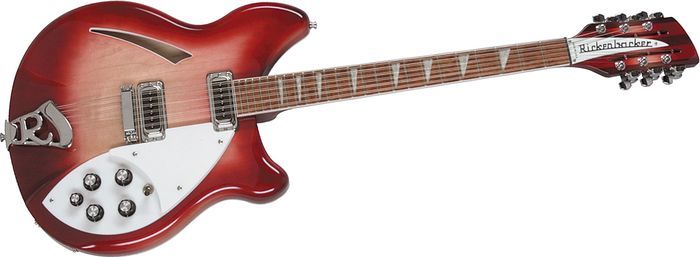
Rickenbacker Guitar is a Old But Cool

The Rickenbacker 360 is a semi-acoustic/ thinline guitar made by Rickenbacher, and part of the Rickenbacker 300 Series. The instrument incorporates many features standard on Rickenbacker guitars, including a three-ply maple/walnut neck, shallow headstock angle, a thick rosewood fretboard finished with clear conversion varnish, and double truss rods. The 360 also features stereo or mono output, a body with Rickenbacker's "crescent moon" cutaway shape and rounded top edge and bound back, and an "R"-shaped trapeze tailpiece. A twelve string version of the Rickenbacker 360 is available (Rickenbacker 360/12). A three pickup version of this model is also available, the 370.


Features
  • No. Frets: 24
  • Scale Length: 62.9 cm (24 3/4)
  • Neck Width at Nut: 41.4 mm (1.63)
  • Neck Width at 12th Fret: 49.05 mm (1 .931)
  • Crown Radius: 25.4 cm (10)
  • Weight 3.6 kg (8.0 lbs.)
  • Overall Length 101 cm (39 3/4)
  • Overall Width 38.1 cm (15)
  • Overall Depth 38.1 mm (1 1/2)


Rickenbacker 360
Manufacturer Rickenbacker
Period 1958 - Present
Construction
Body type Semi-Hollow
Neck joint Set
Woods
Body Maple Carved, with white plastic binding along the back
Neck Three-ply Maple/Walnut
Fretboard Rosewood with pearloid triangle inlays and white plastic binding
Hardware
Bridge Adjustable
Pickup(s) Two Single-coil pickups

Floyd Rose

Floyd Rose Tremolo

Floyd Rose is the organization that licenses, distributes and manufactures the Floyd Rose Locking Tremolo invented by Floyd D. Rose. It also manufactures guitars using the system. Floyd Rose owns the patents on the design, and licenses these patents to several original equipment manufacturers.

The Floyd Rose system consists of:

  • A lock at the nut of the guitar, which prevents the tuning heads from being used and holds the strings taut
  • A "floating bridge", where the other ends of the strings are also vise-locked, hence, "double-locking")

The locking system helps to keep the strings in tune while the strings are slackened to a degree which was not achieved with older tremolo systems, such as those found on Fender Stratocaster, allowing dive bombs, a rapid lowering of the pitch of a note. Since the tuning heads are ineffectual with the lock in place, the Floyd Rose bridge has heads for fine tuning; the guitar is tuned before the lock is put on, then fine tuned afterwards.

Principles

The basic principles of the action of a double-locking floating bridge are shown in this simple illustration. Its proportions are exaggerated to demonstrate the effect.

The basic principles of the action of a double-locking floating bridge are shown in this simple illustration. Its proportions are exaggerated to demonstrate the effect.

Position I illustrates the normal position of an ideally tuned Floyd Rose bridge. The bridge (green) balances on a pivot point, being pulled counter-clockwise by the strings' (red) tension and clockwise by one or several (usually up to five) springs (light blue). Controlled by special tuning screws (sky blue), these two forces are balanced such that the bridge's surface is parallel to the guitar body (olive). The strings are locked tightly with a special mechanism at the nut (also green, as it is a part of the Floyd Rose bridge) as well as at the bridge, hence "double-locking".

Position II illustrates the position of the bridge when the tremolo arm is pushed down towards the guitar body. The bridge rotates around a pivot point counter-clockwise and the tension in each string decreases, lowering the pitch of each string. The sound of any notes being played becomes flat.

Position III illustrates the position of the bridge when the tremolo arm is pulled up away from the guitar body. The bridge rotates clockwise, tension in the strings increases, the pitch of the sound increases and so notes sound sharper than normal.

Note that:

  • All strings are affected simultaneously, as contrasted with the B-Bender, where only one string is affected. Due to the different tensions of each string, the degree of pitch shift will vary from string to string, so the tremolo arm is commonly used on single strings or 2-3 adjacent strings.
  • If the tremolo arm is pushed down, action increases and usually become less comfortable to play due to the lowered tension.
  • If the tremolo arm is pulled up, action decreases and strings may hit the frets on the fretboard, making unwanted sounds. Also, excess tension applied to strings makes them more fragile and increases the chance of string breakage.
Model & Varieties
  • Floyd Rose Original is the oldest model still in production. Since 1977, production models bearing this name are mostly the same as the first model, with only minor changes. Note that the name "Floyd Rose Original" is used to differentiate this system from "Floyd Rose Licensed". The first Original Floyds were double locking but did not have fine tuners, requiring the nut to be opened any time minute string intonation changes needed to be made.
  • Floyd Rose II is a lower end version of the Original Floyd used mostly on import and mid-range instruments. Originally, Floyd IIs were single locking, locking only at the nut. Later versions were made double locking, but used weaker materials than the Original Floyd Rose, making them less dependable.
  • Floyd Rose Licensed are made by other manufacturers that have purchased a license from Floyd Rose. These model generally follow the designs of the Floyd Rose Original, but tend to deviate slightly from the original for the manufacturing process to be more cost-efficient. Most licensed companies use the same design that makes their parts inter-changeable between any two licensed tremolos, but not the Floyd Rose Original. The bridges of such systems are clearly engraved "Licensed under Floyd Rose Patents" and Floyd Rose does not offer any customer support for them. Construction quality of Floyd Rose Licensed tremolos may be compromised due to the cost-efficient techniques, but the reliability of licensed models that match the price of originals are usually high, whereas cheaper variations are often of lower quality as they would have used cheaper manufacturing processes. Two well-known manufacturers of Floyd Rose Licensed tremolos are Schaller and Gotoh.
    • Yamaha Finger Clamp is a variety of Floyd Rose that have build in levers, and thus when tuning, no allen keys are needed.
  • Floyd Rose Derived In order to reduce licensing cost from Floyd Rose, some manufacturer further improve their double locking tremolo that, despite beind double locking, are no longer considered a licensed product, but are distinct relative derived from it.
    • Ibanez Edge is Ibanez's Floyd Rose variant. There are 4 versions including a pro version. These are considered to be the best licensed version and many consider it equal or even better than the Original Floyd Rose. Starting with Edge III and Edge Pro, these are considered as mere derivative, and are not licensed from Floyd Rose.
    • Ibanez Zero Resistance is another of Ibanez's Floyd Rose variant. It uses a ball-bearing mechanic which gives the tremolo more consistency after use, and a stop-bar to help the guitar stay in tune, even with heavy abuse of the tremolo or string break.
    • Ibanez Fixed Edge. While it still uses the locking nut and locking bridge, it was mounted on top of the body, and was used not as a tremolo system, but to provide even more tuning stability on a hardtailed guitar (they can go out of tune during bending, with fingers)
  • Fender Deluxe Locking Tremolo. A specially designed system that was made by Fender Musical Instruments Corporation in conjunction with Floyd Rose himself, utilizing locking tuners, a normal Fender 2-point synchronized tremolo with locking bridge saddles and a special low-friction LSR Roller Nut which allows strings to slide during tremolo use. This is a double locking system, except the other locking point is at the tuner instead of nut.
  • Floyd Rose 7-String is a redesign of Floyd Rose Original for 7-string guitars. The design and working principles are otherwise the same.
  • Floyd Rose Pro is a low-profile version of Floyd Rose Original. The bridge and arm design is changed in such a way that the guitarist's hand will be generally closer to the strings while holding the tremolo arm. The bridge has a narrower string spacing (0.400 inches or 10.16 mm in this design versus 0.420 inches or 10.66 mm of the Floyd Rose Original). Fine tuners are slightly angled for more comfortable play.
  • Floyd Rose SpeedLoader Tremolo is a redesign introduced around 2003 that combines Floyd Rose Original with the SpeedLoader system to produce a new design that overcame many disadvantages of the original Floyd Rose Locking Tremolo design, but required special strings.
Setting up

To remove a string, one must first unlock it at the nut with an allen wrench, loosen the string, unlock it at the bridge with an allen wrench, and then remove the string. To install a new string, you must either cut the ball end off or run the string backwards down the guitar, leaving the ball end at the tuning gear, then reverse the process of removing a string.

Some models, such as Yamaha's Floyd Rose license, include build-in cranks that operate the clamps, and thus need less allen keys, while others, such as Fender's Deluxe Locking Tremolo, is basically "normal" floating tremolo and tuners, but each with locking mechanism, and incorporate friction free (roller base) nuts.

With the newer Edge Pros on certain Ibanez guitars, such as the JEM and JS and RG series, it is not necessary to cut the ball ends. They are equipped with a top sliding string block that you loosen with an allen key to allow insertion of the string from the top. This improves string life and tuning and speed of string change.

info : wikipedia


Saturday, November 17, 2007

Johny Cash

Johny Cash "The Man In Black"


Johnny Cash, born J. R. Cash, (February 26, 1932 – September 12, 2003) was an American, multi-Grammy Award-winning influential country/rock and roll singer-songwriter. Cash was the husband of country singer and songwriter June Carter Cash.

Cash was known for his deep, distinctive voice, the boom-chick-a-boom or "freight train" sound of his Tennessee Three backing band, his demeanor, and his dark clothing, which earned him the nickname "The Man in Black." He traditionally started his concerts with the simple introduction "Hello, I'm Johnny Cash."

Much of Cash's music, especially that of his later career, echoed themes of sorrow, moral tribulation, and redemption. His signature songs include "I Walk the Line," "Folsom Prison Blues," "Ring of Fire," "That Old Wheel" (a duet with Hank Williams Jr.), "Cocaine Blues," and "Man in Black." He also recorded several humorous songs, such as "One Piece at a Time," "The One on the Right Is on the Left," "Dirty Old Egg-Sucking Dog" and "A Boy Named Sue"; rock-and-roll numbers such as "Get Rhythm"; and various railroad songs, such as "Rock Island Line" and "Orange Blossom Special".

He sold over 50 million albums in his nearly 50-year career and came to occupy a "commanding position in music history."

"The Man in Black" was born J. R. Cash in Kingsland, Arkansas, to Ray and Carrie Cash, and raised in Dyess, Arkansas. He was reportedly given the name "J. R." because his parents could not agree on a name, only on initials. Giving children such names was not an uncommon practice at the time. When he enlisted in the United States Air Force, the military would not accept initials as his name, so he adopted John R. Cash as his legal name. Then when signing with Sun Records in 1955, he took Johnny Cash as his stage name. His friends and in-laws generally called him John, while his blood relatives often continued to call him by his birth name, J. R.

Cash was one of seven children: Reba Hancock, Jack, Joanne Cash-Yates, Tommy, Roy, and Louise Cash Garrett. His younger brother Tommy Cash also became a successful country artist. By age five, J.R. was working in the cotton fields, singing along with his family as they worked.

The family farm was flooded on at least one occasion, which later inspired him to write the song Five Feet High And Rising. His family's economic and personal struggles during the Depression shaped him as a person and inspired many of his songs, especially those about other people facing similar difficulties.

Cash was very close to his brother Jack, who was two years older. In 1944, Jack was pulled into a whirling table saw in the mill where he worked, and almost cut in two. He suffered for over a week before he died.[4] There was some talk that Jack's death might not have been accidental; a local bully was seen running from the shop with blood on his shirt, shortly before Jack was found. However, Cash did not discuss that theory in his autobiography, nor the report in some circles that Cash made investigation of the incident a personal obsession. Cash often spoke of the horrible guilt he felt over this incident. According to Cash: The Autobiography, his father was away that morning, but he and his mother, and Jack himself, all had premonitions or a sense of foreboding about that day, and his mother urged Jack to skip work and go fishing with his brother. Jack insisted on working, as the family needed the money. On his deathbed, Jack said he had visions of Heaven and angels. Decades later, Cash spoke of looking forward to meeting his brother in Heaven. He wrote that he had seen his brother many times in his dreams, and that Jack always looked two years older than whatever age Cash himself was at that moment. It is widely thought that the dark side of his world view was shaped by this traumatic event.

Cash's early memories were dominated by gospel music and radio. Taught by his mother and a childhood friend, Johnny began playing guitar and writing songs as a young boy. In high school he sang on a local radio station. Decades later, he would release an album of traditional gospel songs, called My Mother's Hymn Book. Traditional Irish music that he heard weekly on the Jack Benny radio program, performed by Dennis Day, influenced him greatly.

Cash enlisted in the United States Air Force. After basic training at Lackland Air Force Base and technical training at Brooks Air Force Base, both in San Antonio, Texas, Cash was assigned to a U.S. Air Force Security Service unit at Landsberg, Germany.

From his early days as a pioneer of rockabilly and rock and roll in the 1950s to his decades as an international representative of country music to his resurgence to fame as both a living legend and an alternative country icon in the 1990s, Cash has influenced countless artists and left a body of work matched only by the greatest artists of his time. Upon his death, Cash was revered by the greatest popular musicians of his time.

Cash nurtured and defended artists on the fringes of what was acceptable in country music even while serving as the country music establishment's most visible symbol. At an all-star TNT concert in 1999, a diverse group of artists paid him tribute, including Bob Dylan, Chris Isaak, Wyclef Jean, Norah Jones, Kris Kristofferson, Willie Nelson, and U2. Cash himself appeared at the end and performed for the first time in more than a year. Two tribute albums were released shortly before his death; Kindred Spirits contains works from established artists, while Dressed in Black contains works from many lesser-known artists.

In total, he wrote over a thousand songs and released dozens of albums. A box set titled Unearthed was issued posthumously. It included four CDs of unreleased material recorded with Rubin as well as a Best of Cash on American retrospective CD.

In recognition of his lifelong support of SOS Children's Villages, his family invited friends and fans to donate to that charity in his memory. He had a personal link with the SOS village in Diessen, at the Ammersee-Lake in Southern Germany, near where he was stationed as a GI, and also with the SOS village in Barrett Town, by Montego Bay near his holiday home in Jamaica. The Johnny Cash Memorial Fund was founded and contributions can be made here.

In 1999, Cash received the Grammy Lifetime Achievement Award. In 2004, Rolling Stone Magazine ranked Johnny Cash #31 on their list of the 100 Greatest Artists of All Time.

In a tribute to Cash after his death, country music superstar Gary Allan included the song "Nickajack Cave (Johnny Cash's Redemption)" on his 2005 album entitled Tough All Over. The song chronicles Cash hitting rock bottom and subsequently resurrecting his life and career.

For a period of time, there was a museum called the "House of Cash", but it is no longer in operation. Highway 31E, Hendersonville's Main Street, is known as "Johnny Cash Parkway".

On November 2 – November 4, 2007 the Johnny Cash Flower Pickin' Festival was held in Starkville, Mississippi, the city where Cash had been arrested over 40 years earlier and held overnight at the city jail on May 11, 1965, inspiring Cash to write the song "Starkville City Jail". The festival, where he was offered a symbolic posthumous pardon, honored Cash's life and music, and is expected to become an annual event.

info : wikipedia

Dave Baksh

SUM 41 Guitarist Life

David Nizaam Baksh (born 26 July 1980 in Toronto, Ontario, Canada) is the lead guitarist and vocalist of heavy metal/reggae band Brown Brigade, but most notably, he is the ex-lead guitarist of Canadian rock band Sum 41.

Baksh's father, who is of Indian origin, emigrated from Guyana to Canada before Dave was born.

Baksh is married to Jennifer Baksh and still enjoys listening to his old band Sum 41, as well as bands like NOFX, Metallica, Green Day, Tenacious D, Megadeth, Slayer, Anthrax, Iron Maiden, and Rage Against the Machine.

Baksh joined Sum 41 as the third member, after Deryck Whibley and Steve Jocz formed the band in the summer of 1996. In addition to being the lead guitarist, Baksh also provided back-up vocals. He generally plays a Paul Reed Smith McCarty Double Cut Solid body, but he also plays Paul Reed Smith Single Cuts and Gibson Les Pauls and also a Gibson X-Plorers studio (Alpine White). For his pedals, he uses MXR Effects, a Digitech Whammy, and Dunlop wah Pedals. He uses Marshall Amplification as well. Baksh was Diagnosed with OCD at age of 13.

Baksh went by the name Pleasure in Sum 41's alter-ego band, Pain for Pleasure. Baksh also goes by the name Dave Brownsound Baksh, or also "Hot Chocolate", probably playing off of both his Indian heritage and brown sound, the name Eddie Van Halen coined for his own guitar tone. He has stated his favorite Sum 41 songs are Mr. Amsterdam, Machine Gun, Pain For Pleasure, and The Bitter End.

On May 11, 2006, Baksh announced in a statement through his management company that he was leaving Sum 41 for personal reasons. He explained that he couldn't keep trying to express himself through guitar skills without being a pain to the band. During the post-Chuck hiatus, he decided it was time to move on from Sum 41 and to focus on his side project "Brown Brigade", his new band that he founded with his cousin Vaughn and with which he currently plays lead guitar and does vocals.


Billy Joe Armstrong

Green Day Guitarist

Billie Joe Armstrong (born February 17, 1972, in Oakland, California) is the lead vocalist, main lyricist, and guitarist for the band Green Day and the guitarist for the punk rock band Pinhead Gunpowder.

Armstrong grew up in Rodeo, California, the youngest of six children. His father, Andy Armstrong, was a retired Minor League Baseball catcher, who worked as a jazz musician and truck driver for Safeway to support the family. He died of cancer on September 1, 1982 when Armstrong was 10. The song "Wake Me Up When September Ends" is a memorial to his father. His mother Ollie worked as a waitress at Rod's Hickory Pit, where Armstrong and Mike Dirnt got their first gig during their teen years.

Armstrong's interest in music started at a young age. He recorded a song titled "Look For Love" at the age of five on the Bay Area label "Fiat Records". As a teenager he originally was into metal music, but got into punk after hearing the Sex Pistols song "Holidays in the Sun". He attended John Swett High School, and then Pinole Valley High School, dropping out on February 16, 1990, a day before his 18th birthday, to pursue his musical career. While in high school he was nicknamed "Two Dollar Bill", because he was supplying the school with marijuana joints for two dollars.

Guitar

Armstrong's first guitar was indeed a Cherry Red Hohner acoustic which he received from his dad, which he mentions in the book Nobody Likes You- Inside the Turbulent Life, Times and Music of Green Day. Armstrong received his first-- and most famous-- electric guitar, a Fernandes Stratocaster copy that he named "Blue", when he was eleven. Armstrong was shocked when his mother bought the guitar from Armstrong's teacher, because he knew their family were no where near to be able to afford it. He modified the guitar to have a humbucking pickup in the bridge position. He initially installed a Bill Lawrence pickup but later switched to the Duncan JB model. He toured with this guitar from the band's early days and into their first few major-label tours. "Blue" also appears in several of their music videos starting with "Longview", and appearing most recently in "Minority". Armstrong has made several replicas of this guitar and uses them at concerts. He also owns several Gibson SG models which he has removed all of the sound/tone knobs except for one volume.

Today Armstrong mainly uses Gibson and Fender Guitars. Twenty of his Gibson guitars are Les Paul Junior models from the mid to late-1950s. His Fender collection includes: Stratocaster, Jazzmaster, Telecaster, and his Fernandes, "Blue". He states that his favorite guitar is a 1956 Gibson Les Paul Junior he calls "Floyd". He bought this guitar in 2000 just before recording their album Warning.

Armstrong also has his own line of Les Paul Junior guitars from Gibson.

Awards

  • Esquire awarded him an "Esky" for Best Frontman in the Esky Music Awards in the April 2006 issue.
  • Kerrang! magazine awarded him the Best Dressed Star and Hero of the Year in 2005
  • The California Music Awards awarded him Outstanding Male Vocalist in 2001 and 2004
  • Nickelodeon's Kid's Choice Awards Blimp for Favorite Band/Group - April 2005 and 2006
  • Nickelodeon's Kid's Choice Awards Blimp for Favorite Song for "Wake Me Up When September Ends" - April 2006
  • Grammy for Best Rock Album for American Idiot - February 2005
  • Grammy for Record of the Year for "Boulevard of Broken Dreams" - February 2006
  • Grammy for Best Alternative Music Performance for Dookie - February 1995
  • Won 6 MTV VMA Moonmen for Boulevard of Broken Dreams and 1 for American Idiot - August 2005
  • Won 2 American Music Awards for Favorite Pop/Rock Album (American Idiot) and Favorite Alternative Artist - November 2005
  • Won 2 ASCAP Honor Awards for Creative Voice and Song of the Year ("Boulevard of Broken Dreams") - May 2006
  • Won 2 MTV Europe Awards for Best Album and Best Rock Group - November 2005

Thursday, November 15, 2007

SLASH

-Slash- Still Alive

Saul Hudson (born July 23, 1965), more widely known as Slash, is an English-American guitarist best known as the former lead guitarist of Guns N' Roses and as the current lead guitarist of Velvet Revolver. Known for wearing an accentuated top hat, he is regarded by some as one of the greatest guitarists of all time.

Slash was born in Hampstead, an affluent neighbourhood in London, England to a white Jewish English father and a Nigerian mother, both of whom were involved with show business. Slash's mother worked as a costume designer for David Bowie, and his father was an artist who contributed live ensembles to Neil Young and Joni Mitchell. Slash was raised in the city of Stoke-on-Trent, Staffordshire, until the age of 11, when he relocated to Los Angeles, California with his parents in the mid-1970s. He was given the nickname "Slash" by family friend Seymour Cassel, according to whom Saul "was always in a hurry, zipping around from one thing to another."

First steps of an icon

At the age of 14, Slash was given his first guitar by his grandmother. Reveling in the artistry of his hard rock idols, he would spend several hours a day practicing. Eventually, his entire focus was put on music and he made the decision to quit school. In a Rolling Stone article, he remarked:

“

My big awakening happened when I was fourteen. I'd been trying to get into this older girl's pants for a while, and she finally let me come over to her house. We hung out, smoked some pot and listened to Aerosmith's Rocks. It hit me like a fucking ton of bricks. I sat there listening to it over and over, and totally blew off this girl. I remember riding my bike back to my grandma's house knowing that my life had changed. Now I identified with something.”

In addition to Aerosmith, Slash's early influences included AC/DC, Alice Cooper, Black Sabbath, Jeff Beck, Eric Clapton, Iron Maiden, Rory Gallagher, Jimi Hendrix, Led Zeppelin, Queen, Rolling Stones, Thin Lizzy, Van Halen and Frank Zappa.

As his skills improved, Slash became enamored by the hard rock scene on the infamous Sunset Strip. Having both failed auditions to join Poison, Slash and childhood friend, Steven Adler, formed Road Crew in 1983. The band had difficulties retaining members due to their blues-based sound that was entirely different from traditional glam metal. When Slash put out an ad in a newspaper calling for a bassist, he quickly received a response from an enthusiastic Duff McKagan, who would later join Slash and Adler in

the famed Guns N' Roses. When Road Crew called it quits, Slash joined a local band known as Black Sheep (not to be confused with the '70s NY-based rock group.) Headed by Willie Bass, the band shared an agent with another upstart group of misfits known as Hollywood Rose. In 1984, both bands opened for Christian metal band Stryper. After the show, Slash and lead singer Axl Rose were introduced to one another by a mutual friend. The two quickly became friends, and several months later, Slash and Steven Adler were asked to join the newly revamped Guns N' Roses, with Axl Rose, Duff McKagan and Izzy Stradlin. The rock scene in LA at that time was hugely incestuous, so it was no surprise that the five like-minded souls would eventually gravitate together.

The rise of Guns N' Roses

Gritty, young, and reckless, Guns N' Roses toured bars and opened for larger acts throughout 1985 and 1986. It was during this period that they wrote most of their classic material, including "Welcome to the Jungle", "Sweet Child o' Mine", and "Paradise City". As they pushed their way to the forefront of LA hard rock, the band was approached with several lucrative record contracts. Opting to sign to Geffen, they spent half of their advance on clothes, and the other half on alcohol and drugs. It was during this period that the "Most Dangerous Band In The World" tag was first attached to them. In 1988, Slash remarked:

“

For some strange reason, Guns N' Roses is like the catalyst for controversy, even before we had any kind of record deal.”

When Appetite for Destruction appeared in the summer of '87, the hype had reached staggering proportions. A tour with Iron Maiden was canceled when Slash was packed off to Hawaii to kick his drug habit, while Axl ended up in intensive care at

an LA hospital after attacking a police officer. When the press saw the album cover - a controversial Robert Williams painting of a girl being raped by a robot - the hype went into overdrive. Thankfully, the music more than lived up to the band's reputation. By 1988, Guns N' Roses scored it's first #1 hit with "Sweet Child o' Mine", a song spearheaded by Slash's memorable riff and legendary guitar solo. In the years following its release, critics and fans continue to hail Appetite for Destruction as a landmark album that solidified Slash's place as one of the greatest guitarists of all time. To this day, many of his riffs and solos are still featured in "best of" lists around the world. With 15 million copies sold in the United States, it is the second highest selling debut album of all time, behind Boston's debut album.

In 1988, Guns N' Roses released G N' R Lies, an EP best remembered for its featured single, the acoustic song "Patience". Though this album only had eight tracks (four of which had already been released), it was immensely successful, selling over 5 million copies. After a four year hiatus, Guns N' Roses returned with the epic Use Your Illusion discs. The albums indicated a change in musical direction for Guns N' Roses, including more artistic and dramatic songs like "November Rain" and "Estranged". Songs in this vein, along with ballads such as "Don't Cry", contributed to mounting tensions that would ultimately tear the band apart just a few years later. As Rose expressed a desire to pursue more progressive

genres, Slash and McKagan fought to maintain their traditional sound as a punk/blues-based hard rock band. Slash later cited this issue as a key component to his inability to work with Rose on any creative level.

Despite the turbulent production of the albums, Use Your Illusion I and Use Your Illusion II are considered by many to be the band's most ambitious effort. While both discs received lukewarm reviews, critics lauded Slash's work as "sublime". His most acclaimed song is arguably 'Coma', a 10 minute heavy metal ode to his two infamous drug overdoses. In 1991, Guns N' Roses embarked on the 28-month long Use Your Illusion Tour, coinciding with the release of their new albums. Upon completion of the tour, Slash became an American citizen.

After the release of "The Spaghetti Incident?", an album for which he and Duff McKagan had strongly petitioned, Slash began to drift in and out of the band, fru

strated by the lack of activity and communication between him and Rose. In the mid-90s, he wrote several songs for what would have become Guns N' Roses' follow up album to Use Your Illusion I and II. Rose rejected the material, leading Slash to form Slash's Snakepit, a side-project that saw support from Matt Sorum, Gilby Clarke, Dizzy Reed, Mike Inez, and Eric Dover. The band recorded Slash's material and released It's Five O'Clock Somewhere in 1995. Critically, the album was praised for ignoring the conventions of grunge and alternative music. It also fared well on the charts, eventually selling over 1.2 million copies in the United States with little promotion from Geffen.

In an attempt to salvage the wreck that Guns N' Roses was becoming, Zakk Wylde, initially of Ozzy Osbourne fame in the late eighties and early nineties, was invited to jam with the band, but both Slash and Wylde agreed that Gn'R did not have space for two of the world's pre-eminent lead guitarists, although they remain good friends to this day. Wylde went back to work with Rose in the studio in the late nineties, but was alleged to have a more efficient work-ethic than Rose, and no recordings transpired.

On October 30, 1996, it was discovered that Slash

was officially no longer a part of the band, as lead singer Axl Rose sent a fax to MTV stating he and his former guitarist had experienced several disagreements regarding the band's musical direction, and ultimately parted ways.

A crucial moment leading up to Slash's decision to quit the band occurred when Rose removed a section of his guitar track on a cover of "Sympathy for the Devil". Without his consent, Rose replaced Slash's guitar overdub with the work of Paul Tobias, a friend of Rose whom Slash and the rest of the band vocally disapproved of for years. Additionally, as revealed on a VH1 special, Slash stated that he never truly forgave Axl for his spiteful rant regarding some of his fellow band-mates during a 1989 concert.

After Guns N' Roses

After his departure from Guns N' Roses, Slash focused on his side-project, The Snakepit, playing a few tour dates before disbanding the group in 1998. Over the next decade, Slash would become an in-demand session guitarist, recording music with the likes of Alice Cooper, Sammy Hagar, Insane Clown Posse, Ronnie Wood, Bad Company, Cheap Trick, Ray Charles, Stevie Wonder, and Rod Stewart.

In 2001, he chose to regroup Slash's Snakepit to release his second solo effort, the aptly titled Ain't Life Grand. The album managed to do well on the charts, reaching platinum status. To promote it further, Slash embarked on an extensive world tour with AC/DC in the summer of 2000.

In 1990, Slash collaborated with Michael Jackson on his comeback album, Dangerous. He performed guitar on two hit singles, "Black Or White"(song intro) and "Give In to Me". He later appeared in the "Give In To Me" video with Jackson and performed on special occasions during the massive Dangerous World Tour. In 1995, he appeared on stage with Jackson for the MTV Music Video Awards. Slash also played guitar in "D.S.", a controversial song from the 1995 HIStory album. In 2001, Slash once again collaborated with Jackson, on the Invincible track "Privacy". Also in 2001, he joined Jackson on stage at the Michael Jackson: 30th Anniversary Special performing guitar for "Black Or White" and "Beat It".

In 1995, Quentin Tarantino asked Slash to contribute music to his famed adaptation of Jackie Brown. Several Snakepit compositions can be heard throughout the film. In 1996, Slash collaborated with Marta Sanchez to record the flamenco inspired "Obsession-Confession" for the Curdled soundtrack. The song was received well by Smooth Jazz radio stations. Later that year, Slash also played live with Alice Cooper at Sammy Hagar's club Cabo Wabo in Cabo San Lucas, Mexico. The show was recorded and released the following year as A Fistful of Alice.

In 1997, Slash (alongside the late Ol' Dirty Bastard and hit alternative rock band Fishbone) appeared on BLACKstreet's rock remix version of their hit single "Fix". In 2003, he participated in the Yardbirds' comeback record Birdland, released on the Favored Nations label. He played lead guitar in the track "Over, Under, Sideways, Down." In early 2003, Slash also made an appearance at a rally to protest the coming War in Iraq called "Peace on the Beach." Specifically, Slash performed the song "Imagine" by John Lennon. Ed Kowalczyk provided vocals during this performance.

In 2002, he reunited with Duff McKagan and Matt Sorum for a benefit/tribute concert for Randy Castillo. Realizing they still had the chemistry of their days in Guns N' Roses, they decided to form a new band together. The band that featured Slash, McKagan, and Sorum also featured former Buckcherry members Keith Nelson and Josh Todd. Later Duff put out a statement that Josh and Keith didn't quite fit with the band, and they added Dave Kushner as rhythm guitar and, after a long search, Stone Temple Pilots singer Scott Weiland. In 2006, Slash performed a guest spot on keyboardist Derek Sherinian's solo album Blood of the Snake covering the 1970 Mungo Jerry hit single "In the Summertime", also featuring Billy Idol on vocals. A video was also made featuring Slash, Billy, and Derek for this song.

info : wikipedia

Saturday, November 10, 2007

Tom Morello

Tom Morello

Thomas Baptist Morello (born May 30, 1964) is a Grammy Award-winning American guitarist of the bands Rage Against the Machine and Audioslave. He performs as a solo acoustic artist under the pseudonym The Nightwatchman. He is known for his unique guitar style and his outspoken politics.

Tom was ranked #26 on Rolling Stone magazine's list of "100 Greatest Guitarists of All Time". Tom was also one of 20 contemporary guitarists Rolling Stone magazine featured in their "The Top 20 New Guitarists" article along with John Mayer, Derek Trucks, John Frusciante, Warren Haynes and other contemporary guitarists.

Morello was born in Harlem, New York. His mother, Mary Morello, who is part Irish and part Italian, is a founder of Parents for Rock and Rap, an anti-censorship group. She was also a teacher at Libertyville High School. His father, Ngethe Njoroge, was a Mau Mau guerrilla and revolutionary. Morello's great-uncle, Jomo Kenyatta, was the first elected president in Kenya.

Morello grew up in Libertyville, Illinois, at the time a virtually all-white suburb of Chicago. There he attended Libertyville High School. He played French horn in the school band, sang in the chorus, and was active in speech and drama club. (One prominent role was Oberon in A Midsummer Night's Dream.)

He showed his political leanings early. Morello has described himself as having been "the only anarchist in a conservative high school", but has since identified as a nonsectarian socialist.[4] In the 1980 mock elections at LHS, he campaigned for a fictitious anarchist "candidate" named Hubie Maxwell, who came in fourth place after Jimmy Carter at the overwhelmingly Republican school. Ronald Reagan won the mock election. He also wrote a piece headlined "South Africa: Racist Fascism That We Support" for the school's alternative paper, The Student Pulse.

At age 13, Morello purchased his first guitar at Rigoni Music in Libertyville. He wanted a solid-body Ovation guitar, but he didn't have the money to buy one. Instead, he purchased a Kay guitar. Wanting to learn how to play "Black Dog" by Led Zeppelin, he took two guitar lessons, but instead was taught the C-major scale. He decided that playing the guitar was a waste of his time, so he placed it in his closet for the next four years.

Around 1984, Morello first started studying the guitar seriously. He had formed a band in the same year called the Electric Sheep which featured future Tool guitarist Adam Jones on bass. Jones wasn't originally in the band; he was a replacement for a member who quit because he felt his musical skills were far superior to those of the other Sheep. Few if any of the Sheep could really play an instrument at first (Most of their songs consisted of a single chord), but the band was an impetus for Morello to start honing his skills. Instead of performing cover songs, the Sheep wrote original material that included politically charged lyrics. None of the songs composed by the Sheep contained solos; soloing was a skill that Morello began learning in college.

At the time Morello's musical tastes lay in the direction of heavy metal, particularly Kiss, Alice Cooper, Led Zeppelin and Black Sabbath. Morello developed his own unique sound through the electric guitar. Later his music—and musical politics—were greatly influenced by punk rock bands like The Clash, the Sex Pistols and Devo.

Morello graduated in 1982 and began attending Harvard University. There he made a point of practicing every day for up to eight hours without fail, no matter how much studying he had to do. He graduated in 1986 with an honors degree in political science. He moved to L.A., where he briefly worked as an aide to Senator Alan Cranston as he set about trying to join or start a band. (Adam Jones moved to L.A. as well; Morello introduced Jones to some of his future bandmates.)

In 1988 Morello joined Lock Up,a glam rock band that released one album through Geffen Records before splitting up. This record was called Something Bitchin' This Way Comes, which enjoyed only slight success at the time.

Morello had been crushed by the lack of success he experienced in Lock Up. He visited a club in Los Angeles where Zack de la Rocha was rapping. After viewing de la Rocha's lyric books, Tom asked him to front a band. Morello drafted Brad Wilk, a drummer who had unsuccessfully auditioned for Lock Up, and de la Rocha introduced the two to his friend Tim Commerford. The four formed a new band, Rage Against the Machine.

Rage had great success, especially in North America and Europe. Their first, self-titled album, was recognized by fans for Morello's innovative guitar as well as its originality (being one of the first records to combine rock and hip-hop). Morello expressed his attitude toward songwriting during this period as overtly political:

"A good song should make you wanna tap your feet and get with your girl. A great song should destroy copcars and set fire to the suburbs. I’m only interested in writing great songs."

After four years of silence and rumors of break-ups, the band released its second album, Evil Empire. The album moved away from the traditional metal guitar work of the first album; it was experimental in nature and demonstrated Morello's ability to use the guitar in strange ways.

In 1999, the band released The Battle of Los Angeles, their most commercially successful record. In late 2000, they released another album entitled Renegades. Shortly before the release, de la Rocha left Rage, and the band's instrumentalists said they wanted to continue making music together.

Billboard reported on January 19, 2007 that there were rumors that Rage Against the Machine could reunite at the Coachella Valley Music and Arts Festival. These rumors were confirmed in a Los Angeles Times article on January 22 and later on the band's official website. On April 29, 2007, the band reunited at the Coachella Music Festival. This was originally thought to be a one-time affair, but it later turned out not to be. The band later played four shows in the Hip Hop festival Rock the Bells with the Wu Tang Clan, Public Enemy and Cypress Hill, and later an additional night in New York City after the first night sold out in twenty minutes. Rage also played their first (non-festival) concert in 7 years at the Alpine Valley Music Theater in East Troy, Wisconsin, supported by Queens of the Stone Age in August 2007. It is unknown whether Rage Against the Machine has reformed officially, but played more live events co-headlining spots at New Orleans' Voodoo Music Experience in late October and the Vegoose festival which ran from October 26–October 28 in the Las Vegas metropolitan area.

It was later announced that the band will play two shows in Australia in January 2008. The concerts, in Sydney at the Sydney Entertainment Centre on January 22 and Melbourne at Festival Hall on January 30 respectively, sold out in under 3 minutes, making this a record for the band. It was also announced that Rage will be co-headlining all of the Big Day Out venues in Australia and New Zealand along with Bjork and Arcade Fire.

On October 11, 2007, a 2008 Japan tour was announced. According to the band's official website, Rage will be playing three shows in Japan, in Osaka on February 7, 2008 at the Osaka Castle Hall and in Tokyo on February 9, 2008 and February 10, 2008 at the Makuhari Messe.